 The Federal Tax Authority (FTA) has announced that businesses must complete Corporate Tax registration within 90 days from the Date of Incorporation / MOA.
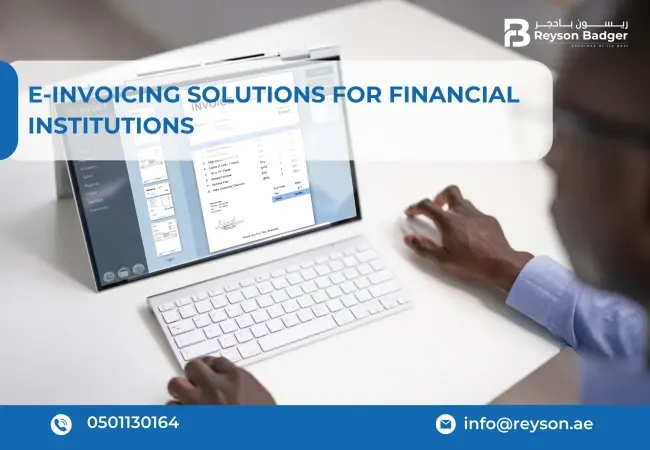


E-invoicing is the process of sending and receiving invoices in a digital format that computers can read, instead of using paper or PDF files. For financial institutions, using e-invoicing solutions is an important step in digital transformation. It helps reduce manual work, gives better visibility of cash flow, and ensures compliance as more governments around the world make e-invoicing mandatory.
In addition to meeting regulations, e-invoicing allows banks and financial companies to improve customer service by offering faster and more accurate billing. It also opens doors to new financial services like invoice financing and early payment discounts. With countries like the UAE already moving toward mandatory e-invoicing, financial institutions must be ready to adapt. More than just a cost-saving tool, e-invoicing is becoming a key driver of efficiency, innovation, and long-term growth.
What is E-Invoicing?
E-invoicing allows invoices to be generated, transmitted, received, and processed in a standardized electronic format (often via networks like PEPPOL or national access points). In the financial ecosystem, e-invoices flow into accounts payable (AP) and accounts receivable (AR) systems and can be validated against tax authorities in near real-time. Global adoption is accelerating as countries implement Continuous Transaction Controls (CTC) or near-real-time reporting models.
Importance of E-Invoicing for Financial Institutions
E-invoicing streamlines complex operations across treasury, trade finance, and transaction banking. It ensures regulatory compliance with tax and reporting mandates, reduces disputes and manual reconciliation, and improves the customer experience by enabling faster, more transparent payments. As regulators (including the UAE) publish timelines for mandatory e-invoicing, banks and financial institutions must position themselves to support clients and take advantage of new service lines (e.g., e-invoice financing, request-to-pay).
Key Benefits of E-Invoicing Solutions for Financial Institutions
- Regulatory compliance: Automated reporting meets government mandates and reduces audit risk.
- Enhanced efficiency & cost reduction: Less manual invoice processing, lower error rates, and faster cycle times.
- Improved accuracy & transparency: Structured data enables automated matching and fewer disputes.
- Strengthened data security: Secure exchange standards and accredited access points protect sensitive financial data.
- Faster payments & cash-flow optimization: Quicker invoice validation enables early-payment and supply-chain finance opportunities.
- Better integration with core systems: Seamless feeds into ERP, core banking, and AML / KYC tooling improve overall operations.
E-Invoicing and Risk Management
E-invoicing reduces fraud and strengthens audit trails by ensuring invoices are authentic, tamper-evident, and traceable. For banks handling invoice financing or factoring, structured e-invoices improve collateral verification and lower the risk of duplicate financing. Proper implementation also supports tax audit readiness by preserving metadata and timestamps required by tax authorities.
Leading e-invoicing vendors offer features that further reduce risk: global compliance networks and government-clearing integrations that validate invoice authenticity before payment, supplier portals that improve transparency, and embedded invoice-financing marketplaces that connect banks with verified receivables. Advanced providers also use AI and machine-learning to detect anomalies and flag suspicious activity early, while robust APIs help integrate e-invoices with core banking, ERP and KYC/AML systems, strengthening controls across the entire financing lifecycle.
Challenges Financial Institutions Face in Adopting E-Invoicing
- High initial implementation costs: Integration, accreditation, and onboarding demand investment, especially for institutions with legacy core systems.
- Legacy system integration issues: Disparate ERPs and siloed data complicate end-to-end automation.
- Staff training and change management: Operational teams need new processes and skills for automated exception handling.
- Regulatory fragmentation: Different countries use different formats and models (PEPPOL, national CTCs, PINT), increasing complexity for cross-border banks.
Choosing the Right E-Invoicing Solution for Financial Institutions
When selecting an e-invoicing solution tailored to financial institutions, it's essential to look beyond compliance examine scalability, integration capabilities, security, and automation.
Key Features to Evaluate:
- Compliance readiness: The platform must align with local and international regulations, including the UAE’s upcoming e-invoicing framework, while being adaptable to evolving tax and reporting requirements.
- Scalability: Financial institutions handle very high transaction volumes, so the solution should process peak loads without disruption or delays.
- Integration capability: Seamless API integration with ERP systems, core banking platforms, payment gateways, and AML/fraud monitoring tools ensures smooth financial workflows and reduces manual intervention.
- Security & encryption: Given the sensitivity of financial data, strong end-to-end encryption, secure data storage, and adherence to local data residency laws are essential for building trust and avoiding compliance breaches.
- Automation level: Advanced automation using AI and machine learning enables accurate invoice matching, proactive fraud detection, and efficient exception handling, reducing operational costs and errors.
Future of E-Invoicing in Financial Institutions
E-invoicing is moving toward fuller automation and richer financial services. Expect tighter links to request-to-pay flows, trade finance, and supply-chain finance; wider use of AI for anomaly detection; and experimental use of blockchain for provenance in high-trust corridors. Global regulatory alignment initiatives (e.g., ViDA in the EU) and national mandates (like the UAE’s e-billing program) will make e-invoicing a core banking service offering rather than a back-office nicety. Financial institutions that invest in integration and productization can create new revenue streams while reducing risk.
E-invoicing is no longer just a back-office efficiency tool it has become a vital requirement for financial institutions in the UAE and worldwide. By adopting the right e-invoicing solutions, banks and financial firms can improve compliance, reduce costs, speed up payment cycles, and build stronger customer trust. At Reyson Badger, we help financial institutions stay ahead of regulatory changes while embracing automation, security, and seamless integration. With our expertise, your institution can transform invoicing into a smarter, more reliable process that supports long-term growth and compliance in an increasingly digital economy.