 The Federal Tax Authority (FTA) has announced that businesses must complete Corporate Tax registration within 90 days from the Date of Incorporation / MOA.


Mandatory e-invoicing in the UAE is a major digital transformation initiative led by the Federal Tax Authority (FTA) to modernize VAT compliance, improve transparency, and automate invoice reporting across businesses. Under the UAE e-invoicing system, VAT-registered businesses will be required to issue invoices in a structured electronic format (such as XML), instead of traditional paper or PDF invoices, ensuring real-time accuracy and regulatory visibility. As e-invoicing in the UAE becomes mandatory in a phased rollout beginning from 2026, it is crucial for businesses in Dubai, Abu Dhabi, Sharjah, and across the UAE to clearly understand the step-by-step compliance requirements, system integration process, and technical obligations. The move toward mandatory e-invoicing in the UAE will not only strengthen tax compliance and reduce fraud but also enhance automation, improve data accuracy, lower operational costs, and support the country’s broader digital economy vision.
Overview of the UAE E-Invoicing System
Under the mandatory e-invoicing in the UAE, all VAT-registered businesses must issue tax invoices and credit notes in a structured digital format such as XML or JSON, as per the UAE e-invoicing requirements issued by the Federal Tax Authority (FTA). These e-invoices must comply with approved technical standards, such as PINT AE or UBL (Universal Business Language), to enable real-time invoice validation, automated tax reporting, and secure data exchange through accredited service providers. Traditional paper invoices, scanned copies, and unstructured PDF invoices will not be accepted as valid e-invoices in the UAE once the system becomes fully mandatory. This digital shift supports VAT compliance in the UAE, reduces fraud, improves transparency, and enables seamless business automation.
Role of the Federal Tax Authority (FTA) and Accredited Service Providers (ASPs)
The Federal Tax Authority (FTA) controls and monitors the e-invoicing system in the UAE and sets all the rules that businesses must follow. Companies do not send invoices directly to the FTA. Instead, they must use an FTA-approved e-invoicing service provider (ASP). These approved providers help businesses create invoices in the correct digital format, safely send invoices to customers, and automatically share the invoice data with the FTA. For mandatory e-invoicing in the UAE to work properly, both the seller and the buyer must be connected to approved service providers.
What Businesses Should Prepare Before Onboarding?
Before starting e-invoicing in the UAE, businesses must prepare a few important things to avoid delays and compliance issues:
- Upgrade Your Accounting or ERP System: Make sure your accounting software, ERP, or billing system can create structured e-invoices in XML or JSON format as required under UAE e-invoicing rules (PINT AE / UBL standards).
- System Integration Readiness: Your existing ERP, POS, or accounting software must be ready to connect with the Accredited Service Provider (ASP) through APIs or direct integration for smooth invoice exchange.
- Understand FTA Data Requirements: Businesses must follow the FTA e-invoicing data dictionary, which includes mandatory details such as:
- Seller & buyer information
- VAT TRN numbers
- Invoice number & date
- Item descriptions
- VAT amount & total invoice value
- Secure Digital Invoice Storage: You must be ready to store e-invoices and credit notes securely in FTA-approved digital formats for audits, tax filing, and long-term compliance.
Mandatory E-Invoicing in UAE: What Businesses Need to Do?: 6 Key Steps
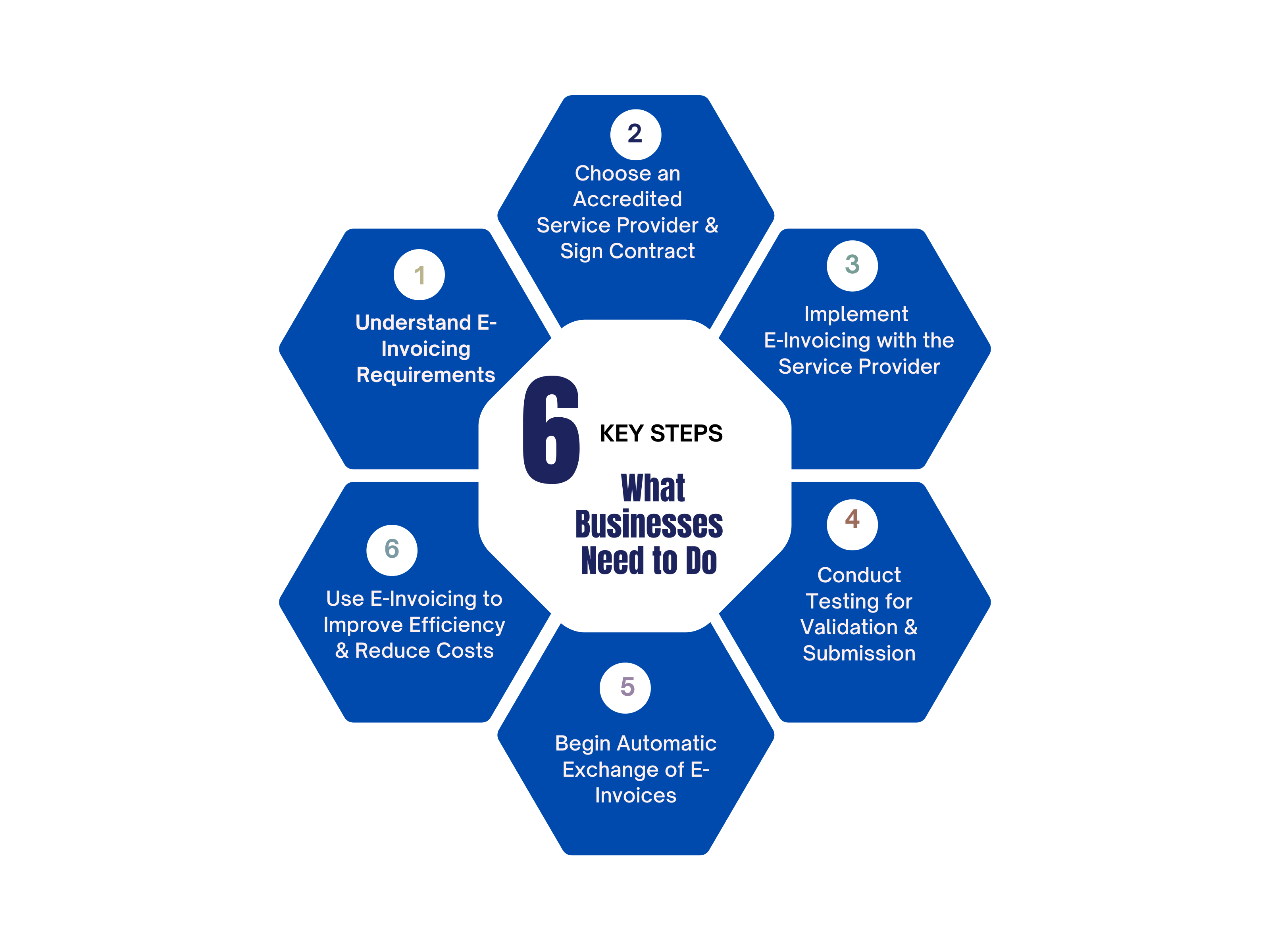
Step 1: Understand E-Invoicing Requirements
Businesses need to grasp what counts as a valid e-invoice under UAE law: structured XML/JSON format, compliant with PINT AE or UBL specs; containing all mandatory data fields (seller & buyer info, TRNs, invoice number/date, itemized goods/services, VAT breakdown, totals); and when required, digitally signed or encrypted for tamper-proofing
Step 2: Choose an Accredited Service Provider & Sign Contract
Because direct integration with the FTA e-invoicing infrastructure is reserved for ASPs, businesses must select and contract an FTA-accredited ASP. The choice is important — features, integration capabilities with your existing ERP or accounting system, reliability, technical support, pricing, and ability to handle real-time or near real-time invoice exchange all matter.
Before signing, check:
- The ASP supports the required invoice formats (PINT AE / UBL)
- That it offers API/integration support or plug-ins for your accounting/ERP system
- That it follows FTA’s security, encryption, and archiving standards
- Support for both issuing and receiving invoices (if you are a buyer and supplier)
Step 3: Implement E-Invoicing with the Service Provider
Work with the chosen ASP to integrate your ERP/Accounting/POS system (or billing software) such that invoices are generated in a compliant XML/JSON format. Map all required fields from your billing data to the FTA-prescribed data dictionary, ensure VAT calculation logic, itemization, line-items, etc., are accurate.
Step 4: Conduct Testing for Validation & Submission
Before going live, perform thorough testing with the ASP: generate e-invoices; run validation/clearance logic; ensure invoice data is accepted by the ASP and passes FTA schema/validation rules; confirm buyer-side reception and acknowledgement; verify that data transmission to FTA works as expected; test handling of credit notes or corrections if applicable. Ensure data integrity, digital signatures (or other cryptographic protections), and that any system failures or exceptions are properly handled.
Step 5: Begin Automatic Exchange of E-Invoices
Once testing is successful, switch live: issue all B2B and B2G invoices via the ASP, transmit them electronically to buyers and to the FTA. The ASP handles clearing/validation, submission, and archiving on your behalf.
Step 6: Use E-Invoicing to Improve Efficiency & Reduce Costs
With digital, automated invoicing in place, businesses can streamline operations, reduce the risk of data-entry errors, speed up invoice issuance and transmission, enable faster reconciliation, simplify audits, and maintain a clean, tamper-resistant invoice archive. Over time, this reduces invoice production cost, manual workload, and the risk of compliance errors while providing a more reliable VAT trail for audits or government scrutiny.
How Reyson Badger Supports E-Invoicing Compliance
- Guidance on selecting an appropriate Accredited Service Provider (ASP): Evaluate provider capabilities (format support, integration, security, support), compare pricing, and select a partner aligned with business needs.
- Technical setup & implementation assistance: Help map existing invoicing data (from ERP/accounting/POS) into structured XML/JSON per FTA specifications (PINT AE / UBL); assist in ERP/POS integration or plugin installation.
- Testing support & end-to-end onboarding: Run test invoices, validate with ASP and FTA schema/rules, perform buyer-side receipt testing, troubleshoot errors or validation failures, and ensure the system is ready for “go-live.”
- Ongoing compliance reviews & system support: Help monitor system performance, handle updates (e.g., if FTA data dictionary or format specs change), support secure digital archiving, train staff, manage exceptions or system failures, ensure long-term compliance with UAE e-invoicing regulations.
Conclusion
Mandatory e-invoicing in the UAE is not just a regulatory requirement but a major step toward digital tax compliance, automation, and long-term efficiency for businesses. With structured e-invoices becoming compulsory under FTA regulations, VAT-registered businesses must act early to avoid last-minute risks, system disruptions, or non-compliance penalties. Reyson Badger plays a crucial role in supporting businesses through every stage of UAE e-invoicing implementation, from understanding legal requirements and selecting the right Accredited Service Provider to system integration, testing, and ongoing compliance support. By choosing expert guidance from Reyson Badger, businesses can ensure seamless e-invoicing adoption in the UAE, achieve full FTA compliance, reduce operational costs, and confidently move toward a fully digital finance ecosystem.