 The Federal Tax Authority (FTA) has announced that businesses must complete Corporate Tax registration within 90 days from the Date of Incorporation / MOA.


The UAE is preparing for one of the biggest digital tax transformations with the nationwide rollout of the electronic invoicing system (e-invoicing). Backed by the Ministry of Finance and Federal Tax Authority (FTA), this system will change how businesses issue, exchange, and store invoices.
If you run a VAT-registered business in the UAE, understanding the UAE e-invoicing timeline and deadlines is critical to avoid future compliance risks. This blog clearly explains the official phased implementation based on the 2025 Ministerial Decisions, so you know exactly when and how to prepare.
What is UAE e-invoicing?
E-invoicing in the UAE refers to an electronic invoicing system mandated by the Ministry of Finance (MoF) and Federal Tax Authority (FTA) that requires invoices and credit notes to be issued, transmitted, and stored in a structured digital format (e.g., XML/JSON using the approved schema).
Unlike traditional paper invoices or simple PDFs, e-invoices under this system must pass through an authorized technical infrastructure handled by accredited providers, ensuring compliance, traceability, and real-time (or near real-time) reporting to tax authorities.
Why the UAE Is Introducing an Electronic Invoicing System?
- To digitize and modernize VAT compliance in the UAE by replacing manual and paper-based invoicing with a fully structured, automated electronic invoicing system, making UAE VAT reporting faster, more accurate, and more transparent for all businesses.
- To reduce tax evasion, fake invoicing, and human errors through real-time invoice validation, traceability, and automated audit trails, strengthening VAT control and fraud prevention in UAE businesses.
- To align the UAE’s tax infrastructure with global e-invoicing standards followed in leading economies, supporting international trade, digital transformation, and cross-border compliance under a unified UAE electronic invoicing framework.
- To enhance government oversight and tax revenue efficiency by enabling the Federal Tax Authority (FTA) to monitor taxable transactions in real time through approved Accredited Service Providers (ASPs).
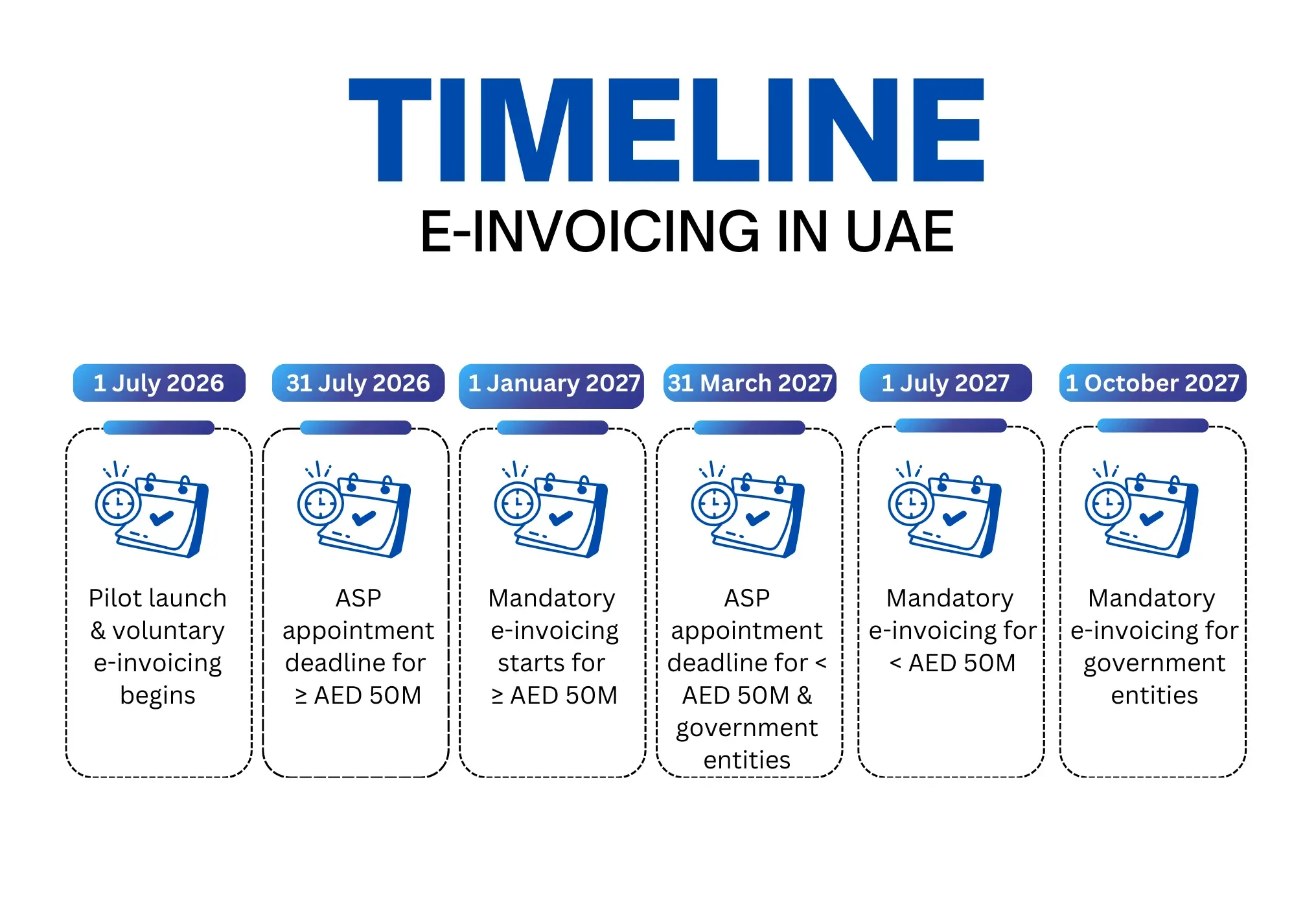
UAE E-Invoicing Timeline Overview
The rollout of e-invoicing in the UAE will be phased. It includes a pilot programme, a voluntary implementation window, and a mandatory implementation schedule with different deadlines based on revenue and whether the entity is private or government.
| Phase / Category | Key Dates / Requirements |
|---|---|
| Pilot Programme | Start: 1 July 2026 Selected businesses (invited by MoF/FTA) will test the system under official supervision. |
| Voluntary Implementation | Also from 1 July 2026, any business may voluntarily begin issuing e-invoices (using approved format & ASP) ahead of mandatory deadlines. |
| Mandatory Implementation Large Businesses (Revenue ≥ AED 50 million) | ASP appointment deadline: 31 July 2026; Mandatory e-invoicing start: 1 January 2027 |
| Mandatory Implementation — Other Businesses (Revenue < AED 50 million) | ASP appointment deadline: 31 March 2027; Mandatory e-invoicing start: 1 July 2027 |
| Mandatory Implementation — Government Entities (B2G) | ASP appointment deadline: 31 March 2027; Mandatory e-invoicing start: 1 October 2027 |
Phase 1: Pilot Programme
- Begins 1 July 2026 under the official framework defined by the 2025 Ministerial Decisions No. 243 & 244.
- Participation is limited only to selected taxpayers (invited by the authorities). These businesses will sign a formal agreement to participate and must comply with all technical and reporting requirements of the e-invoicing system.
- The pilot helps test the system’s readiness, reveal practical challenges, and allow partners (businesses + accredited providers) to fine-tune integration, ERP compatibility, invoice formatting (data fields as per PINT AE schema), and compliance workflows before the wider rollout.
Phase 2: Voluntary Implementation
From 1 July 2026, any VAT-registered business may choose to adopt e-invoicing before their mandatory date. This is optional, but it can be a strategic advantage for early adopters.
Voluntary adoption helps businesses:
- test their accounting/ERP systems for compatibility with the new e-invoicing standards (e.g. output format, integration with ASP, data storage)
- train staff and update invoicing processes ahead of deadlines
- avoid last-minute rush, implementation errors, or compliance risk once the mandate kicks in
Phase 3: Mandatory Implementation
Large Businesses (Revenue ≥ AED 50 million)
Appoint an Accredited Service Provider (ASP) by 31 July 2026.
Start e-invoicing (issue, transmit, store structured invoices) from 1 January 2027.
Businesses With Revenue < AED 50 million
Appoint an ASP by 31 March 2027.
Begin mandatory e-invoicing from 1 July 2027
Government Entities (B2G Transactions)
Appoint an ASP by 31 March 2027.
Mandatory e-invoicing start date: 1 October 2027.
After All Phases Are Complete
Once the phased rollout is complete, all VAT-registered businesses (and in-scope government entities) will need to use e-invoicing via an ASP for B2B/B2G transactions. Paper invoices or simple PDFs will no longer be compliant under the e-invoicing law. Over time, the government may extend the mandate to other categories (e.g. B2C), but as of now, B2C remains excluded.
What Businesses Should Do Now?
Given the upcoming changes, businesses (and advisers) should start preparing immediately:
- Determine your revenue bracket, knowing whether you are above or below the AED 50 million annual revenue threshold, will set your compliance deadline.
- Assess your current invoicing/ERP/accounting system, check whether your system can produce structured invoices or be integrated with an e-invoicing solution; identify gaps in technology, data handling, storage, and processes.
- Plan to engage an Accredited Service Provider (ASP) well before the deadline relevant to your category, large businesses by July 2026, small/medium by March 2027.
- Consider voluntary early adoption, especially if you want to test systems, update processes, train staff, and avoid a rush during the mandatory rollout.
- Prepare documentation, training, and compliance workflows to ensure that invoicing, data storage, reporting, and audit trails are aligned with the technical standards and data-retention rules defined by MoF/FTA.
How Reyson Badger Can Help?
At Reyson Badger, we can support businesses in every step of this transition:
- Clarify which timeline and deadlines apply based on your business size, revenue, and entity type
- Assist in selecting a compliant Accredited Service Provider (ASP)
- Help integrate your accounting/ERP systems with the e-invoicing infrastructure, ensuring compliance with the official data format (PINT AE / Peppol-based) and FTA requirements
- Provide readiness support: system audit, process mapping, training for your finance teams, documentation, and implementation planning
- Offer ongoing compliance support from initial setup to full adoption, ensuring a smooth transition ahead of mandatory deadlines
Conclusion
The UAE e-invoicing mandate marks a major shift in how businesses manage VAT compliance, with clear implementation deadlines between 2026 and 2027 based on revenue and entity type. Whether you are a large enterprise, an SME, or a government entity, early preparation is essential to avoid compliance risks and last-minute disruptions. From understanding your applicable deadline to appointing the right Accredited Service Provider (ASP) and upgrading your systems, expert guidance can make the transition seamless. Reyson Badger supports businesses across the UAE with complete e-invoicing readiness, VAT compliance, and regulatory advisory services, ensuring your business stays fully compliant with the UAE electronic invoicing system and Federal Tax Authority requirements.
FAQs on e-invoicing in the UAE
1. What is the e-invoicing mandate timeline in the UAE?
E-invoicing will become mandatory for most VAT-registered businesses in the UAE, but it will be introduced gradually. The system will first be available on a voluntary basis and then rolled out in phases.
From 1 July 2026, businesses can start using e-invoicing voluntarily or as part of a pilot program. From 1 January 2027, e-invoicing will become mandatory for large businesses that exceed the revenue threshold set by the FTA. It will then be extended to all remaining in-scope VAT-registered businesses from 1 July 2027, mainly covering B2B and B2G transactions.
2. Is a PDF tax invoice considered a valid e-invoice in the UAE?
No. A UAE e-invoice is not the same as a PDF tax invoice. While a PDF may meet VAT content requirements, it is considered a static document and will not qualify as an official e-invoice under the new e-invoicing framework.
3. Are there special considerations for large enterprises?
Yes. Large businesses—especially those operating across multiple countries—may face additional challenges when adopting e-invoicing. These businesses often use multiple ERP systems, which need to be aligned before the January 2027 deadline.
This may require a group-wide approach, standardising invoice data and formats, choosing whether to use one service provider or multiple providers, and strengthening governance to meet UAE e-invoicing requirements.
4. What happens if my business is not ready on time?
If your business is not prepared by the applicable mandate date, you may face VAT reporting issues, penalties, and audit risks. To avoid disruption, it’s important to review your systems and processes early. Contact us to assess your readiness and prepare smoothly for UAE e-invoicing.